





Introduction
In 1791 the engraver Joseph Anton Zimmermann produced a print of the Marian pilgrimage at Dorfen in Upper Bavaria (see Fig. 1). The image offers a dense visual synthesis of space and time as well as the practices surrounding the cult of the miraculous image of the Madonna. In the background rises the pilgrimage church on the Ruprechtsberg named after Saint Rupert of Salzburg (c. 650–718) who is said to have resided on this hill for some time; at its foot lies the small town of Dorfen.[1] In the right foreground the cult image is staged within an elaborate high altar depicting the legendary donation of the rosary (Rosenkranzspende). The enthroned Virgin, holding the Christ Child on her lap and surrounded by putti bearing rose garlands, hands the rosary to Saint Dominic on the left, while Saint Catherine of Siena receives her own rosary on the right. Their presence points to the Dominican order’s formative role in founding the Rosary Confraternity.[2] A crowd of pilgrims — young and old, men and women, bodies marked by illness and disability — presses toward the image in supplication. In the foreground on the left, a girl is holding up a river crab towards a boy with a fishing rod and a woman resting at the pond’s edge. The rural scene embeds the pilgrimage in the everyday life of the surrounding countryside, situating the sacred within rather than apart from the local lifeworld. From the left, further worshippers, laity and clergy together, move in procession towards the Marian cult image. They carry rosaries, processional banners, crosses, and sheets of printed text, most likely devotional song leaflets.
The engraving offers a highly layered composition and staging of the pilgrimage to Dorfen: the site of grace (the church), its source of grace (the Marian shrine), and the acts of devotion directed toward it are presented simultaneously. Zimmermann renders the media and objects of pilgrimage with precision. Rosaries, banners, crosses and printed leaflets do not function as decorative accessories but as the material and textual conditions under which the pilgrimage becomes recognisable as such. The engraving itself operates as a meta-medium, reproducing and circulating the Dorfen cult for a devout public well beyond the shrine’s immediate geographical reach.
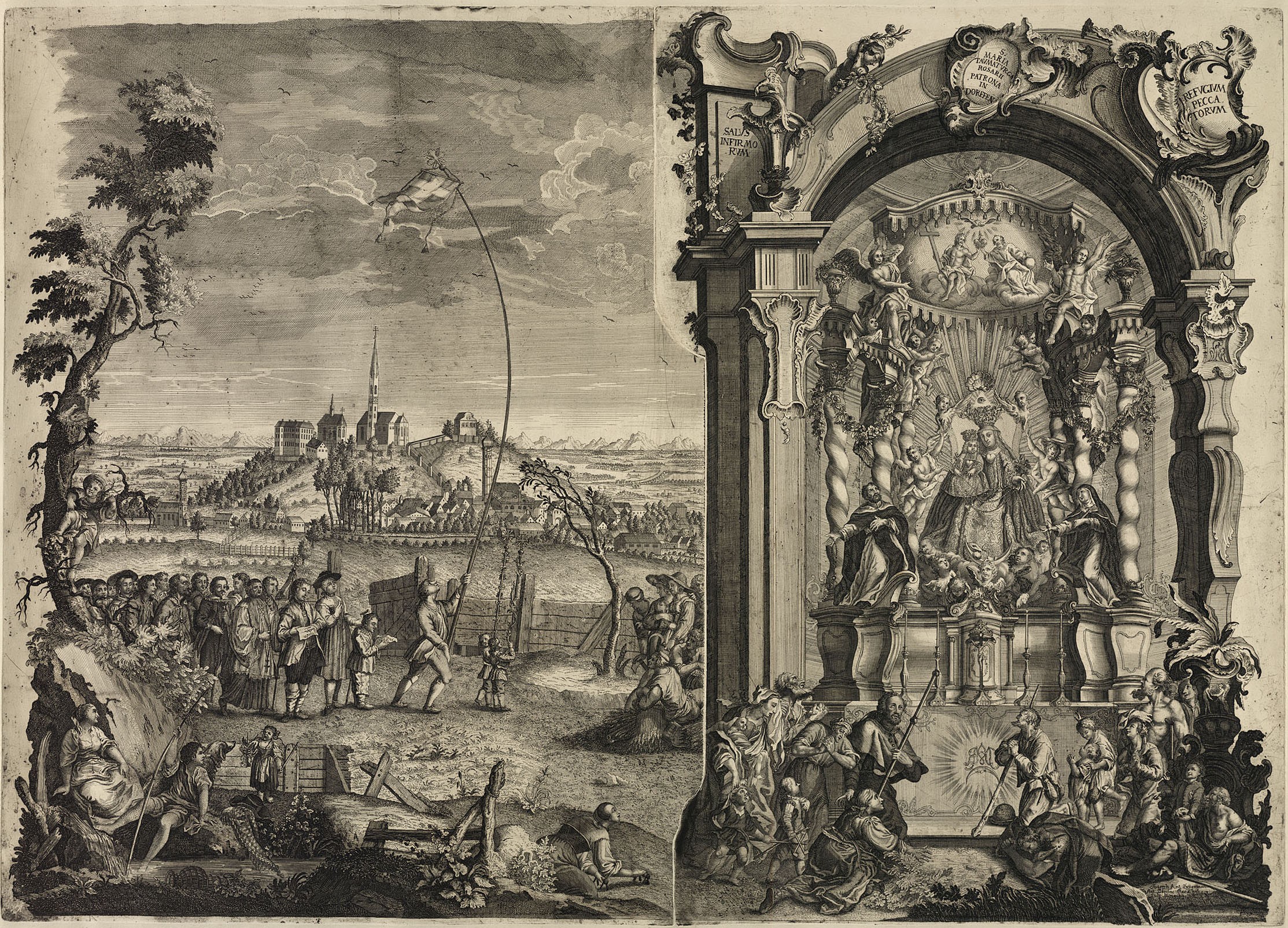
The copperplate print leads us directly into the concern of this article. It asks which media, objects and practices were central to the pilgrimage of Dorfen, and how their interaction can be described and analysed as an instance of ‘condensed mediality’ (verdichtete Medialität). In this sense media and objects are to be understood as central constituents of the pilgrimage as religious practice. The engraving is methodologically instructive in this respect: it does not simply depict a pilgrimage, but reproduces four interlocking levels of mediation simultaneously. First, a spatial level: church, cult image, town and landscape, which together anchor the cult in a specific topography. Second, a material level: rosaries, crosses, and banners, through which devotion is performed by objects. Third, a performative level: the gestural and bodily enactment of piety — processing, praying, kneeling, touching objects to the image. And fourth, a medial level: engravings, miracle reports and other printed media circulated and disseminated the cult far beyond its physical site. The distinction drawn here serves heuristic purposes only; in devotional practice the four levels overlap, interpenetrate and reinforce one another. Mediality, on this reading, is not secondary to the religious practice it is said to represent, but constitutive of it.
The present article rests on a broad understanding of media that follows Birgit Meyer’s work on religion as practice of mediation. Meyer argues for an expansive concept that includes “all kinds of stuff — bones, plants, objects — that operate as media in the sense of means and transmitters,”[3] and approaches religion itself as a practice of mediation through which a professed transcendent is rendered tangible in the immanent. Central to this framework is the notion of the sensational form, which designates the structured, authorised formats — bundling objects, images, texts, gestures and spatial arrangements — through which religious experience is generated and stabilised within specific traditions. This perspective allows material objects and printed media to be treated as members of a common field of mediation rather than as disparate types of artefacts. Furthermore, it invites attention to how these media were combined, authorised and contested and how they produced a religious experience.
This media-centred approach also intersects with recent work on lived religion and religious materiality.[4] Both strands of research ask how faith was constituted materially through things, bodies, spaces and images. This attention to materiality and practice has recently been extended toward the embodied and affective dimensions of devotion.[5] The concept of lived religion also has an advantage over older notions of ‘popular religion’ (Volksreligiosität) since it avoids the binary opposition between an elite and a popular piety on which such categories rest. For most early modern Christians, religious truth was mediated as much through images and objects as through texts. Condensed mediality offers a way to analyse how pilgrimage media and objects rendered religious experience repeatable, transmissible and recognisable as such.
Early eighteenth-century Dorfen witnessed a dramatic expansion of its Marian cult, sustained by a steadily growing market for printed miracle books, devotional prints, sacramentals and consecrated matter. Which actors, objects and media sustained this process, and how did their interaction generate what might be called a ‘condensed mediality’ of pilgrimage? In order to answer these questions I will first outline the historiography and history of the pilgrimage at Dorfen. On this basis I will examine the central devotional objects associated with the cult along three interrelated axes of condensed mediality: medial condensation, the multifunctionality of objects, and intermedial relations.
The Pilgrimage of Dorfen: A Marian Cult between Late Medieval Origins and Baroque Expansion
The historiography of the Dorfen pilgrimage is so far dominated by Albrecht Gribl’s study Unsere Liebe Frau zu Dorfen from 1981.[6] While the book remains valuable for its detailed reconstruction of the cult’s history and material culture, his methodological framework is firmly anchored in the phenomenological tradition of German Volkskunde of the 1970s and 1980s.[7] Within this tradition, devotional objects appear as expressions of an underlying, quasi-universal stratum of human behaviour, oscillating between the sacrum and ‚unreflective use‘ as healing magic or apotropaic instruments.[8]
The present article shifts the focus and asks, instead, how objects, texts, and bodily practices were historically produced as constitutive media of religious practice. It builds on Gribl’s empirical findings but reframes them through the analytical lens of media and material culture studies, and through the concept of ‚condensed mediality’ introduced before.
The pilgrimage to the image of the Virgin Mary on the Ruprechtsberg cannot be documented in writing before the late seventeenth and early eighteenth century; earlier origins are due to the efforts of clergymen, in particular the parish priest Joseph Sailler (1655–1737), who sought to establish a long tradition of pilgrimage. Pilgrimages to Dorfen may have begun already in the fifteenth century, though the claim that earlier records were lost during the Thirty Years‘ War rests solely on witness testimonies recorded in the early eighteenth-century miracle books and may itself form part of the strategic narrative through which the shrine constructed its own tradition.[9] A Marian church, however, did exist on the site by the fifteenth century, and the late Gothic Madonna with Child itself dates from the second half of that century (see Fig. 2).[10] How and when the statue itself came to be set within this church remained unclear even to contemporaries. A note taken in 1726 states that the origin and circumstances of the image’s arrival in the church remained unknown.[11]
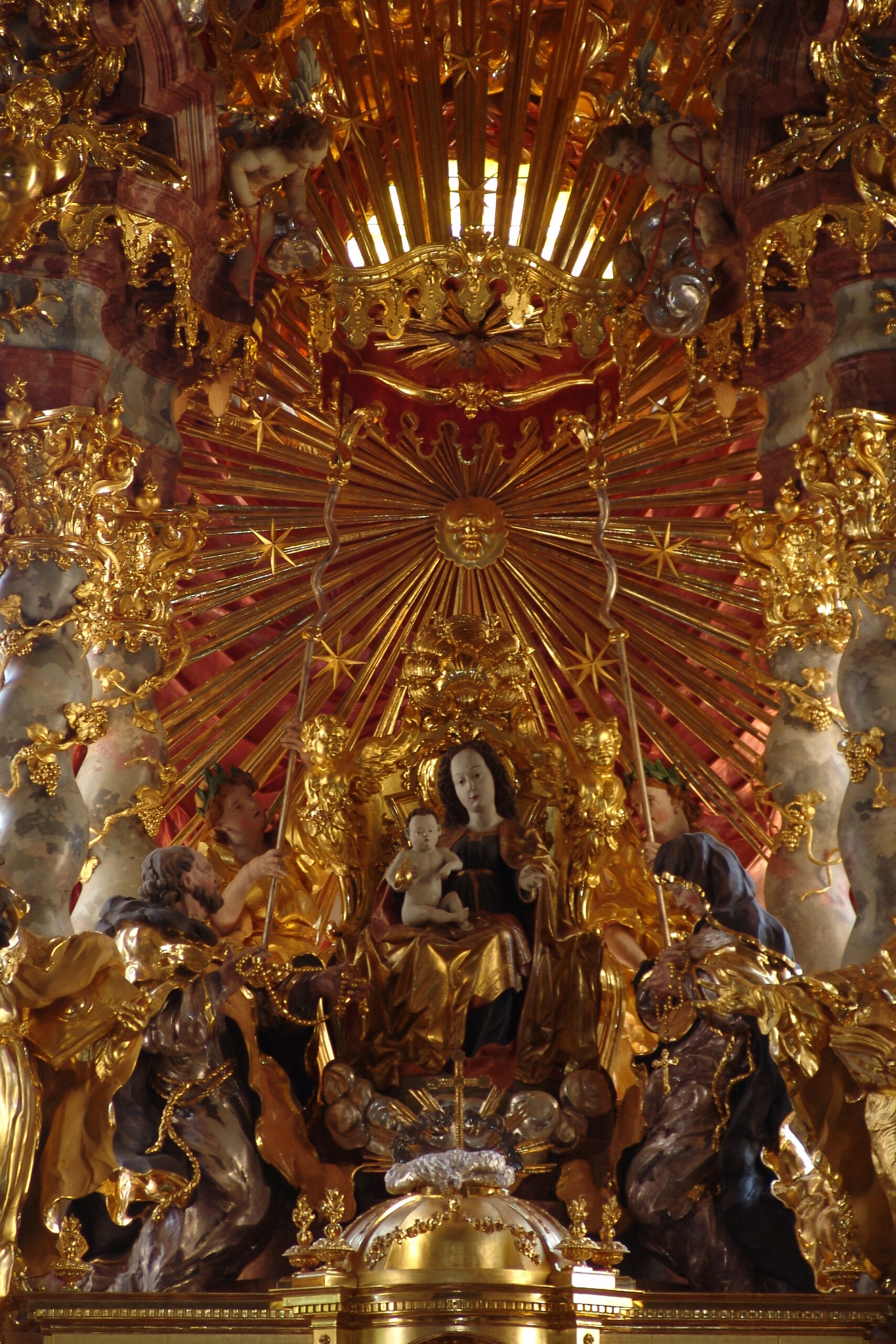
The miracle report Das uralte und liebevolle Gnadenbild Mariä zu Dorfen in Baiern (1781) links the flourishing of the Marian cult to the foundation of a Rosary Confraternity in 1657/58 and the introduction of Lenten sermons and Advent Rorate masses (Engelämter), through which pilgrim numbers and offerings rose sufficiently to finance a marble floor and a silver monstrance.[12] The early eighteenth-century rise of the Dorfen pilgrimage was shaped by a coordinated effort involving three central figures: the parish priest Joseph Sailler, who enlarged the church, commissioned printed sermons, and published collections of answered prayers (Gebetserhörungen), the Prince-Bishop of Freising, Johann Franz Eckher von Kapfing und Liechteneck, and the ecclesiastical councillor (Geistlicher Rat) Philipp Franz Lindmayr. Their collaboration set the institutional and material conditions for the shrine’s rapid expansion.[13] This consolidation culminated in 1707, when an ecclesiastical commission formally declared the image miraculous, and transformed it into a pilgrimage destination of supra-regional significance.
This rise enabled Sailler to undertake the Baroque refurbishment of the pilgrimage church and to commission a Priesterhaus for the resident clergy. For this purpose he secured the services of the architect, painter and sculptor Egid Quirin Asam (1692–1750), who designed the choir frescoes in 1740/41.[14] The opulent Rococo high altar, based on an earlier design of Asam’s from 1728, was erected between 1740 and 1749, with the image of the Virgin in its centre. Dismantled and replaced by a Neo-Romanesque structure in the mid-nineteenth century, the Asam altar was reconstructed between 1963 and 1971 and has framed the cult image in the choir ever since.[15]
Yet the church’s investment was not confined to monumental projects; it extended to small-format objects designed to forge a personal and lasting bond between the individual pilgrim and the cult. According to Das uralte und liebevolle Gnadenbild, Sailler had religious medals (Gnadenpfennige) struck in metal, silver and gilt, and distributed them among the pilgrims according to their social rank, so that they might carry the memory of the Virgin with them and propagate it among others.[16] Dorfen emerged as one of the most popular pilgrimage sites in the Electorate of Bavaria, second only to Altötting, drawing pilgrims from Tyrol, Swabia, the Upper Palatinate, Bohemia, Austria, Styria and Carinthia.[17] Over the course of the eighteenth century, pilgrim numbers reached remarkable proportions: contemporary estimates speak of some four million visitors to the ‘holy mountain’ across the eighteenth century; for the year 1716 alone 45,350 pilgrims were recorded.[18] The shrine also attracted devotees of the highest rank: alongside numerous bishops and noble pilgrims, members of the Wittelsbach dynasty visited Dorfen in the early eighteenth century.[19]
The prosperity generated by the cult left its mark on the town both economically and culturally. However, with the political and ecclesiastical reorganisations around 1800, and above all with the Bavarian secularisation, the pilgrimage declined. Yet the cult image remained present in collective memory through a dense network of copies and reproductions, which circulated above all within the Prince-Bishopric of Freising and the Archdiocese of Salzburg, with isolated examples reaching as far as Vienna, Styria and Vorarlberg. Surviving replicas ranged from altar paintings on high and side altars to images housed in wayside shrines and filial churches, with datings extending from the first half of the eighteenth century well into the nineteenth.[20]
The Making of a Pilgrimage: Condensed Mediality at Dorfen
The early eighteenth-century expansion of the Marian cult at Dorfen was sustained by a steadily growing supply of printed miracle accounts, devotional prints and objects, each item embedded in its own devotional, economic and medial logic.[21] Among the sacramentals available at Dorfen were scraping Madonnas (small clay figures impressed with the image of the Virgin), religious medals, scapulars and rosaries, the latter mainly procured from workshops in nearby Altomünster. Like many established shrines, Dorfen also possessed a sacred oil, kept in a lamp in the immediate vicinity of the cult image, that was believed to work wonders. The physical proximity to the sacred site was decisive for the efficacy of the holy matter. According to contemporary Catholic belief, matters and objects were imbued with sacred power through priestly consecration or through rituals of contact—that is, the touching of the object to a holy site or person (or its remains)—which then passed into the human body through physical interaction. Certain substances, moreover, were believed to possess sacred power intrinsically, without requiring ritual mediation: relics and relic dust, but also particles scraped from holy images or from the very fabric of a shrine, carried their efficacy within themselves. Portable devotional objects thus enabled a »physical bridge of contact extending to the body of the wearer«.[22] As ‘religious wearables’ and ‚mobile proxies‘, they transferred the protective power of shrines, saints and their mortal remains, making it available to the faithful in the most diverse places across the world. [23]
The case of Dorfen exemplifies the process of ‘condensed mediality’ understood as the increasing density and intermeshing of media clustered around the Marian image. What intensified in the early eighteenth century was not only the quantitative flow of pilgrims but also the variety and complexity of the objects and practices through which sense was made of the cult. The cult image, devotional prints, miracle books, rosaries, religious medal, oil and clay figurines, together with the performative acts that activated their sacred power — procession, prayer, touching objects to the image — constituted the pilgrimage itself. Pilgrimage at Dorfen is therefore not a pre-existing practice subsequently represented in text and image, but a religious experience brought into being by mediality. A dispute between the widowed trade woman Anna Maria Heigl and the Landshut merchants’ guild offers a micro-historical entry point into the process of condensation. The case documents the very dynamics it negotiates: the dense and growing network of sacramentals, printed texts and devotional practices that together constituted the pilgrimage as an expanding phenomenon in the early eighteenth century.[24]
Medial Condensation: Prints, Objects and Matters at Dorfen
In 1716, Heigl obtained the permission of the Landshut government to erect a sales stall at the pilgrimage church on the Ruprechtsberg in return for an annual fee to the parish. The resident merchants of Landshut lodged a formal complaint with the city council in the spring of 1717, but did not confine themselves to the written procedure. They demolished Heigl’s stall and threatened to destroy it again should she not abandon her plans at once. When the trader refused to be intimidated, they made good on the threat and tore down the reconstructed stall in broad daylight. After repeated summons from the electoral Hofrat (the sovereign’s supreme administrative and judicial council in Munich) to submit a report, the Rentmeister was instructed to hear the parties during his circuit in October 1717 and to settle the matter ‘amicably’.[25] The latter concluded that Heigl should be prohibited from maintaining a fixed stall and restricted to mobile trade. In his reasoning, the merchants suffered genuine economic damage, since these devotional objects brought in almost as much as ordinary wares and had for some time been in such high demand that production could scarcely keep pace. Moreover, he argued that it had been the parish priest alone who had permitted her to build a stall, without the prior knowledge and consent of the secular authorities. On this basis, the merchants renewed their petition that Heigl be forbidden the devotional trade, since, as they argued, they themselves carried the very same wares. The dispute makes visible that, by 1717, small sacramentals — often considered marginal and ‚worthless‘ — had become materially productive to a degree that drew the attention of the merchants’ guild and the territorial administration alike.
Heigl, however, refused to accept the condition that her assortment of rosaries, scraping Madonnas, devotional prints, scapulars and religious medals be offered only from an open bench, and appealed directly to the sovereign. In January 1718, Elector Maximilian II Emanuel intervened in her favour, permitting Heigl to continue the devotional trade on the grounds that the matter concerned merely ‘the sale of a few indulgence-pennies, images of the Virgin and simple prayer-beads offered at the shrine, just enough to earn a crust of bread.’[26] The merchants objected once again, countering that Heigl’s trade was by no means as moribund as she led the Elector to believe, and that the pilgrimage was in fact flourishing as never before, above all through the circulation of the new miracle books. The merchants thus argued their case through an observation that is highly relevant in this context: printed text legitimates and popularises devotional matter, which in turn drives consumer demand generating the profits the guild wished to claim. The assertion is an explicit, if unintended, diagnosis of the circuit of mutual, intermedial reinforcement between text and object that sustained the shrine’s expansion. The Hofrat in Munich took up this very argument but turned it against the complainants, confirming the widow in her right to the stall on the grounds that the concession redounded to the benefit of the pilgrimage and above all of the church. Having failed before the electoral court, the merchants retaliated in kind and promptly erected their own devotional stalls on the Ruprechtsberg. Although Heigl protested and demanded that the prohibition extend not only to the merchants but also to two other women selling devotional objects at the shrine, the dispute was eventually settled. After Heigl’s daughter Barbara Eder took over the trade on her mother’s death in 1724, the merchants revolted once more two years later—again without success.[27]
The case opens up multiple perspectives on the trade in devotional objects at pilgrimage sites. Resident female traders such as Heigl had to assert themselves on a contested, patriarchally structured market, and they did so at times at the expense of still more marginal actors in the itinerant trade – mostly female mobile traders with no stalls who had to offer their wares from vendor’s trays or small benches. While Heigl emphasised the modest scale of her business and rhetorically positioned herself through the topos of the indigent widow, the merchants pointed to the conspicuous prosperity of the devotional trade. The parish priest, for his part, was primarily concerned with the prosperity of the shrine and the continuing flow of pilgrims; for the civil authorities, what counted was the cultivation of a state-guided Catholic piety among the population in the sense of the pietas bavarica.[28] Equally central to the conflict analysed here is the tension between the religious and the economic functions of sacred space. The proximity to the church certainly boosted sales of devotional objects and promoted veneration of the cult image, but it simultaneously threatened to blur the boundary between legitimate devotion and the commercial exploitation of the sacred.
Over the course of the seventeenth and eighteenth centuries, sacred sites such as Dorfen became stages of a particularly dynamic trade in devotional objects. The growing popularity of the pilgrimage to the Virgin generated an increasing demand for objects that commemorated the spiritual journey and mobilised the efficacy of the sacred site for the practices of domestic piety. Printed miracle accounts documented the miraculous power of sacramentals to free the faithful from suffering or distress, and in doing so instructed them in the proper, devout use of these objects and substances. The most popular sacred matter at Dorfen at the beginning of the eighteenth century was the holy oil, kept in a lamp suspended in the immediate vicinity of the cult image and believed to cure physical and mental illnesses.[29] This was neither new nor specific to Dorfen. Comparable oil cults flourished at other shrines in southern Germany and beyond, most notably the Walburgisöl of Eichstätt, reputedly exuded by the relics of Saint Walburga, and the lamp oil dispensed at the Black Forest pilgrimage of Mary in the Fir (Maria in der Tanne) in Triberg.[30] The two examples illustrate two distinct types of consecrated substance. While the Walburgisöl belongs to the category of relic substances with intrinsic sacred power, the lamp oils of Triberg and Dorfen, by contrast, derived their efficacy from proximity to the cult image and thus operate within the logic of contact sanctity described above. In the everyday practice of the faithful, however, this theological distinction played a subordinate role. The consumption of oil from lamps burning before cult images and relics reached back further still: to early Christianity, when the oil drawn from lamps at the tombs of apostles and martyrs was already believed to carry miraculous healing power.[31] In this long-standing tradition, the belief in supernatural assistance from the saint or shrine merged with a cultural knowledge of the natural medicinal properties of oil.
The first printed miracle book of the Madonna of Dorfen from 1713 records as its “227th benefaction” a cure effected through this oil: in 1711 the organist Ursula Lippin treated her two-month-old baby, who suffered from an internal ailment, during a seven-day devotion with oil from the lamp, whereupon the child was instantly healed.[32] Gribl has identified this first written record as the “nucleus” of a subsequent cult around the oil itself.[33] By the Centuplum I of 1718 three further oil miracles are documented.[34] Shortly before, in 1717, the lamps from which the oil was drawn were clad in silver: a local craftsman produced two silver lamps, one suspended in the choir before the tabernacle, the other before the cult image.[35] In 1768, both lamps were replaced by two new silver vessels commissioned from the workshop of a goldsmith in Landshut.[36] The material trajectory of the lamp itself is telling: from the simple oil lamp to the openwork silver lamps to the sophisticated goldsmith’s work, the vessel progressively acquires the material weight commensurate with the miraculous substance it contains. Furthermore, in 1737 the distribution of the oil was depicted in an image that has not survived.[37] What emerges, however, is a pattern of mutual intensification: a textual record legitimises a substance, the substance attracts new religious narratives, and the material setting is progressively enhanced.
By 1781, when Das uralte und liebevolle Gnadenbild appeared, the miracle book recorded a total of eight healings effected through the oil, grouped in part in a section of their own.[38] Set against the scale of distribution — with up to 700 pounds of oil and 40,000 phials dispensed to pilgrims annually — the number of documented healings appears comparatively modest. The discrepancy in itself is, however, revealing. While the printed miracle books register only the spectacular, formalised wonders, the oil itself circulated as a far broader medium of everyday domestic piety. Pilgrims carried small glass phials home and used the oil both externally, as an unction for wounds and skin ailments, and internally, ingested against inner complaints — including, in some cases, conditions such as deafness, muteness, mental illness or ‘spirit possession’. While most miracle reports record a formal vow to the Virgin (Verlöbnis)—an act that, in official theological understanding, was an integral component of the efficacy of consecrated matter and indeed the precondition for its effect—the sources also document healings that occurred without any such votive act. Magdalena Rebauer from Egglfing, for example, was cured after ingesting Dorfen oil dissolved in water.[39] The efficacy of the consecrated substance was understood to reside in the matter itself, independent of an explicit ritual vow. A particularly striking example to illustrate this is the case of Maria Holzner from Uttendorf, who suffered from what contemporaries described as a ‚devouring worm‘ (“fressender Wurm”) that destroyed her cranial bone.[40] After treatment with Dorfen oil, the Centuplum III reports, her old skull bone came loose and was replaced by a new one; Holzner brought the discarded skull bone to Dorfen as a votive offering.[41] This circuit of return is itself a constitutive element of ‘condensed mediality’ at Dorfen. Pilgrims cured of internal ailments such as renal stones often had the passed concretions mounted in small silver settings and returned them to the shrine as ex-votos, where they joined the accumulating votive display around the cult image. Baron von Lerchenfeld, for instance, vowed himself to the Madonna of Dorfen and was cured of a bladder stone the size of a pea; once it had passed, he had it set in silver and offered it at the shrine.[42] Sacred matter dispensed from the shrine thus re-emerged at the shrine in a transformed material register: the ingested substance returned as silver-mounted concretion; the anointed lesion returned as a painted votive tablet. The body of the pilgrim functioned, in this sense, as a medium of transformation in its own right, converting consecrated matter into tangible evidence of grace.
The cases examined here thus point to a wider devotional logic of physical contact and chains of transmission, through which sacred power was held to pass into matter and from there into the body of the believer.[43] That this contact was meant in more than a metaphorical sense is evident from a striking practical detail: priests used a ladder to bring devotional objects into direct physical contact with the cult image. Mere belief in symbolic proximity was not enough to render an object holy; the actual touching of matter to matter was indispensable.[44] Within this dense web of mutually reinforcing media, individual objects acquired a further, distinct quality. Where the holy oil operated within a relatively narrow functional range—primarily that of healing—the scraping Madonnas exhibit a more pronounced multifunctionality, moving across distinct devotional, therapeutic, protective, and social registers.
The Multifunctionality of Objects: The Example of the Scraping Madonnas
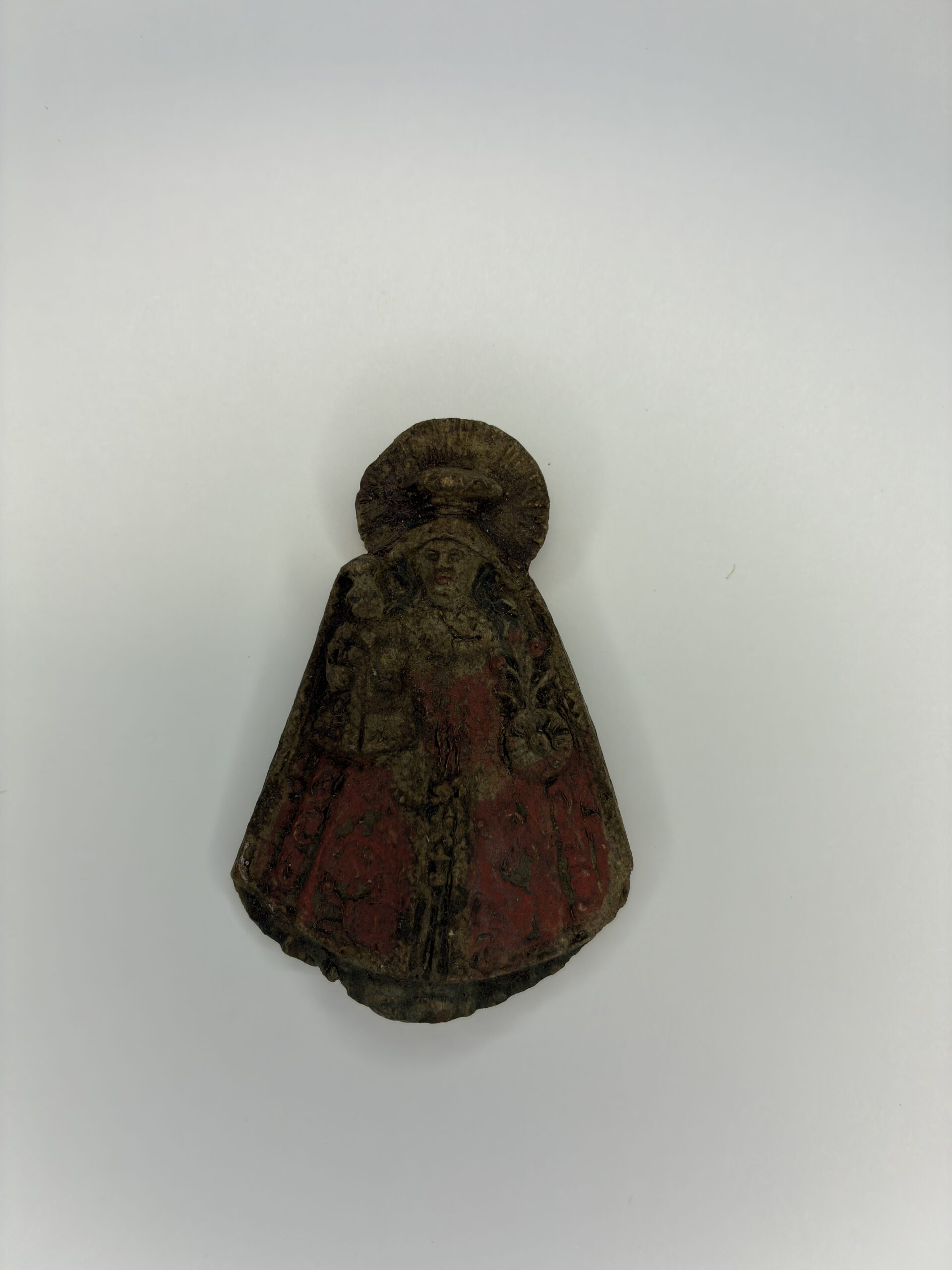
The scraping Madonna (Schabmadonna) was a portable image of the Virgin made of clay, mixed with dust particles from the shrine. Its very substance could be dissolved in water and thus consumed. The figurine thus literally incorporated the cult image into the body of the faithful, collapsing the distinction between object and ingestible substance into a single devotional act. Similar objects were distributed at other Marian shrines including Altötting or Einsiedeln.[45] The underlying logic — sacred matter detached from a holy site and incorporated into the body of the faithful — was not confined to clay Madonnas: At the Lower Austrian pilgrimage site of Sonntagberg, comparable practices centred on so-called Fraisensteine, small fragments scraped or broken from the stone of the high altar that were ingested or applied to the body to ward off epileptic seizures (Fraisen) and other afflictions, especially in children.[46] At Dorfen, these Marian figurines were produced and sold by Anna Maria Heigl and, after her death, by her daughter Barbara Eder, using moulds; they were sold either plain or coloured, the latter by an unidentified female painter.[47] A rare surviving Schabmadonna from Dorfen (see Fig. 3) illustrates the type well. It depicts the seated crowned Virgin with the Christ Child on her lap. The example from the Museum Dingolfing measures 6.7 cm in height, 4.6 cm in width, and 0.8 cm in depth at its maximum extent, and was produced from pale, oxidation-fired clay using a mould technique; on the reverse, the edges were most likely bevelled with a knife while the clay was still unfired, particularly around the head.[48] On the front, remnants of the original polychromy survive, most likely in oil paint: yellow for the crown and the long veil, red for her mantle, for the lips of both Mary and the Christ Child, and for the roses held in Mary’s left hand, black for her hair, blue for the eyes of both figures, and a pale green for the area below the mantle. Oily residues are visible within the halo and along the entire left side of the front. The reverse bears rust stains or other brownish accretions, along with the inventory number painted in white.
The objects themselves were unassuming in appearance and modest in material value — yet precisely this material quality made possible the multiple functions the figurines would come to fulfil.[49] The first register in which the Schabmadonna operated was apotropaic: pilgrims carried the small clay figurines as protective amulets against illness, and other forms of misfortune such as fire. A blacksmith from Ampfing, for instance, kept his clay Madonna in a small pouch on his person to ward off his asthma; a priest in Bohemia, faced with a sudden fire, cast a Schabmadonna into the flames and saw them die down instantly.[50] The second register was therapeutic, paralleling the use of the lamp oil discussed above. Small particles were scraped from the clay, dissolved in liquid and ingested as a remedy, or applied externally to the afflicted part of the body. Georg Haindl of Auerleiten, in the jurisdiction of Frankenmarkt in Upper Austria, had long suffered from a lesion on his right eye that contemporaries diagnosed as “krepsen” (cancer). After a certain woman advised him to scrape particles from the Madonna and apply them to his eye on a small cloth, the wound healed, and in 1780 he undertook a pilgrimage to Dorfen to deposit a votive offering in memory of the cure.[51] The clay figurines were used not only therapeutically but also diagnostically. In his Rituale franciscanum, the Franciscan Bernhard Sannig recommends a procedure for determining whether a sick person is possessed by demons: small particles of the clay Madonna should be dissolved in liquid and stirred into the patient’s soup. If s/he then began to tremble, scream, and lash out, this was taken as a certain sign of possession.[52] Beyond their individual application, the scraping Madonnas frequently operated in combination with other sacramentals, where each object reinforced and potentiated the efficacy of the others. In 1720, a Franciscan nun from Landshut, troubled by recurring asthmatic attacks, vowed to combine the use of the consecrated oil with the practice of carrying a scraping Madonna touched to the cult image at all times.[53]
Another case from the Centuplum II records another Franciscan nun, Maria Benedicta Herbstin from the Convent of the Holy Cross in Landshut, threatened with blindness, who placed the clay figurine on her eyes while simultaneously anointing them with the holy oil.[54] Its efficacy accumulated through coupling: oil and clay, image and substance, were combined, each medium intensifying the chain of transmission through which sacred power passed from the cult image to the body of the believer.
Surviving objects in the collection of the Bavarian National Museum themselves point most clearly to a further trajectory: in many cases they were lifted out of the medicinal circuit altogether and re-framed as protective amulets — mounted in silver or pewter settings, often attached to rosaries, where they acquired the status of heirlooms despite their slight material value.[55] A woman from nearby Vilsbiburg, Barbara Feyrl, who died in 1726, listed among her possessions two wooden crucifixes and “1 erdtenes Frauenbildt“ (one clay image of the Virgin) – probably from Dorfen.[56]
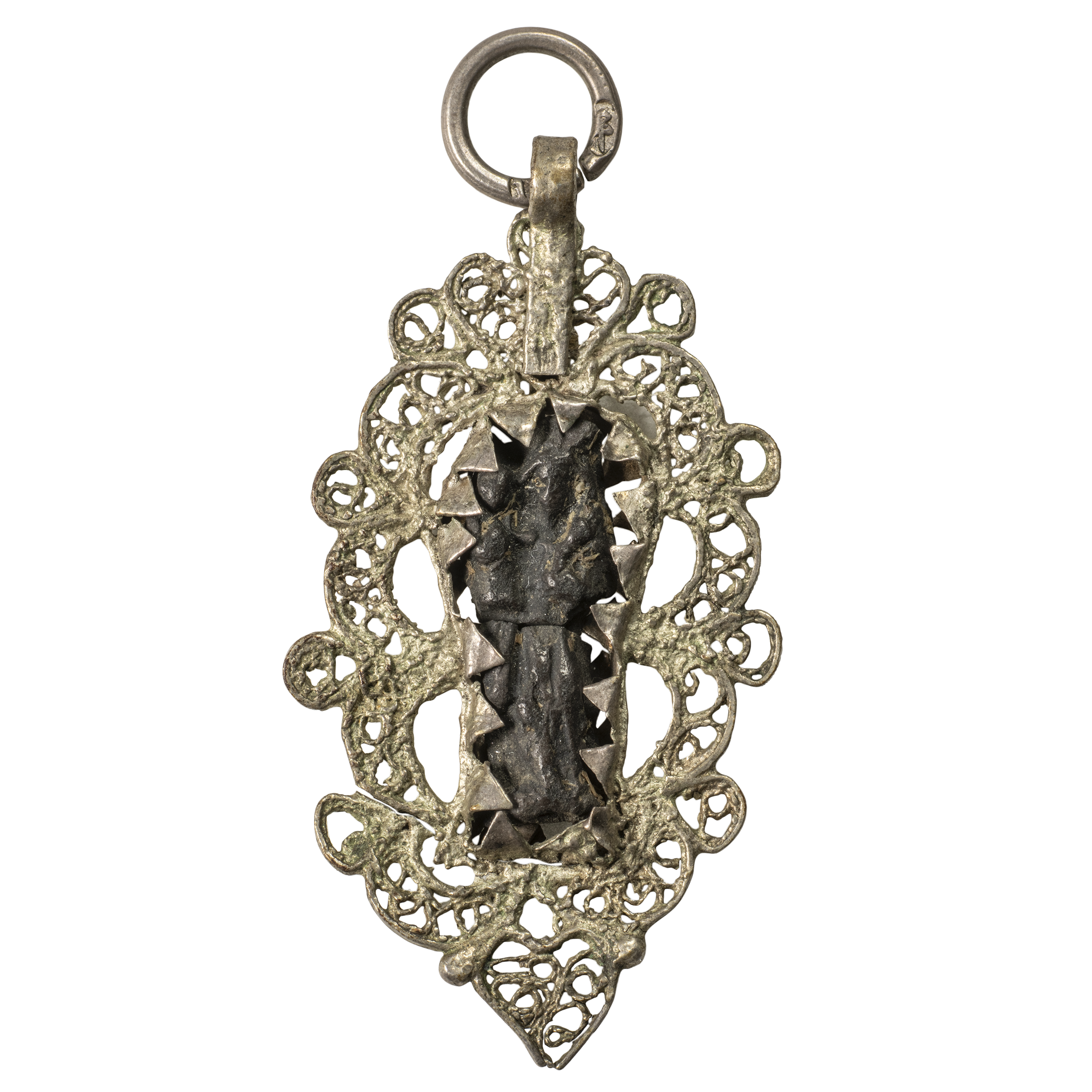
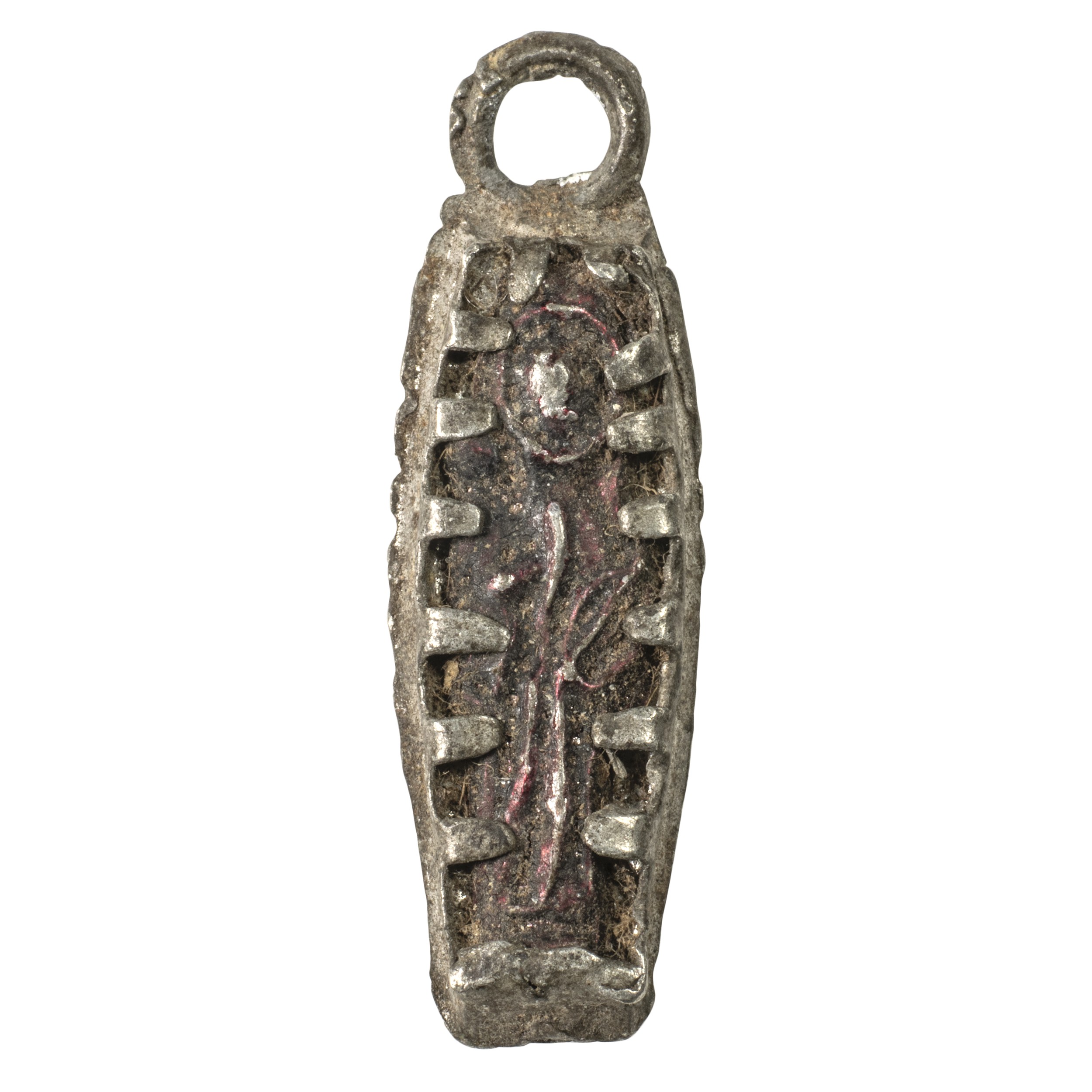
Two examples illustrate the logic of this re-framing. In the first (see Fig. 4), a worn figurine of the Virgin, with faint traces of red pigment still discernible, is enclosed in a pewter mount with a suspension ring and a frame of stylised rays; the reverse bears the inscription “S. MARIA”.
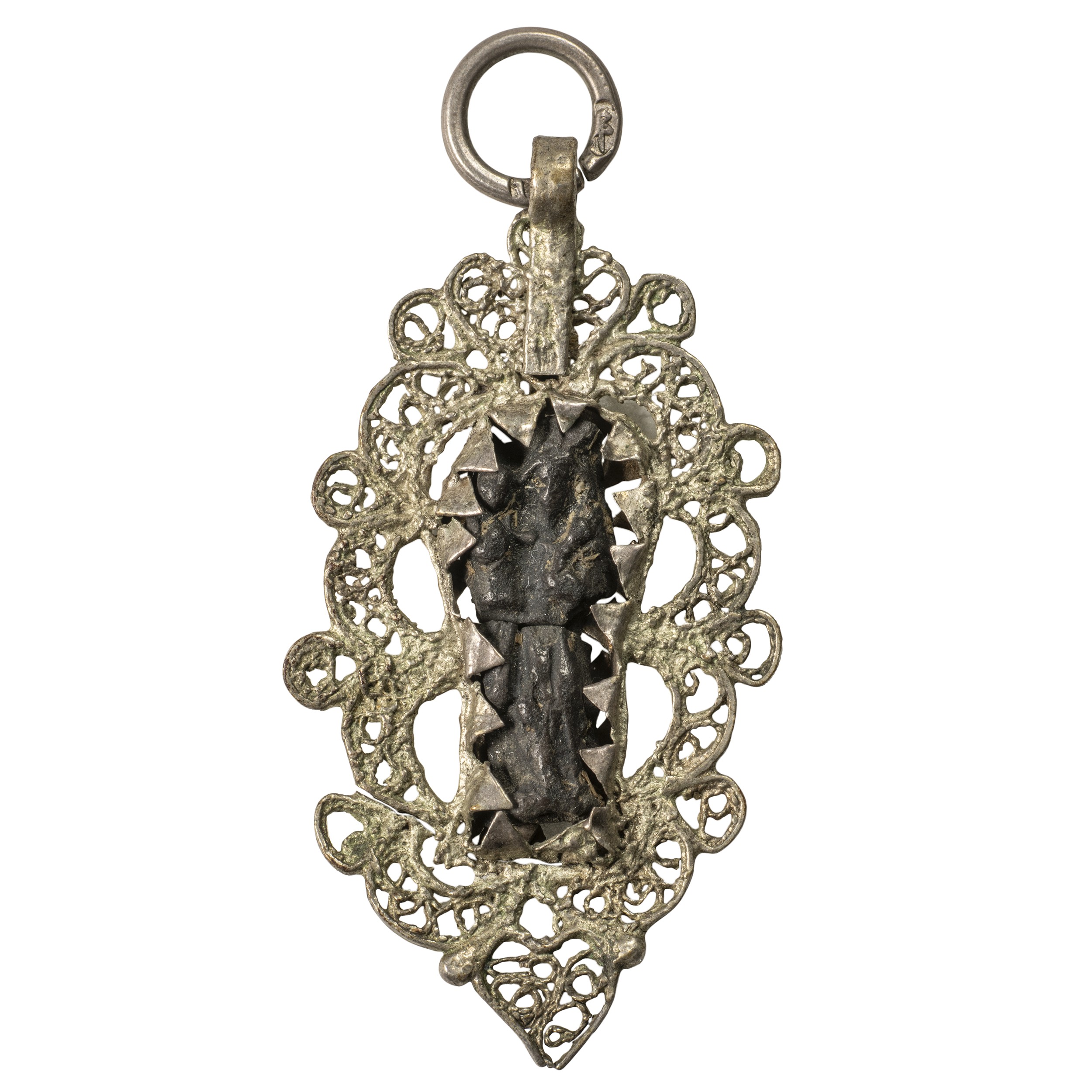
The second (see Fig. 5) shows a figurine — most likely representing the cult image of Altötting, with the Virgin holding the Christ Child on her right arm and a sceptre in her left, the reverse left plain — set into an elaborate silver filigree frame of openwork scrolls, designed to be suspended from a chain or rosary.
The contrast in material value between the two examples — pewter and silver — further suggests that this re-framing operated across a broad social spectrum: the same mass-produced figurine could enter the modest devotional economy of artisan or peasant households as well as the more elaborate object cultures of urban bourgeois or noble piety. In both cases, however, the metal mount performs a double operation: physically, it protects the fragile figurine from further abrasion; semantically, it elevates a mass-produced sacramental into a precious heirloom — shifting the figurine from the consumable circuit of devotional matter into the stable register of objects passed across generations.
Intermediality: Relational Networks Between Devotional Objects
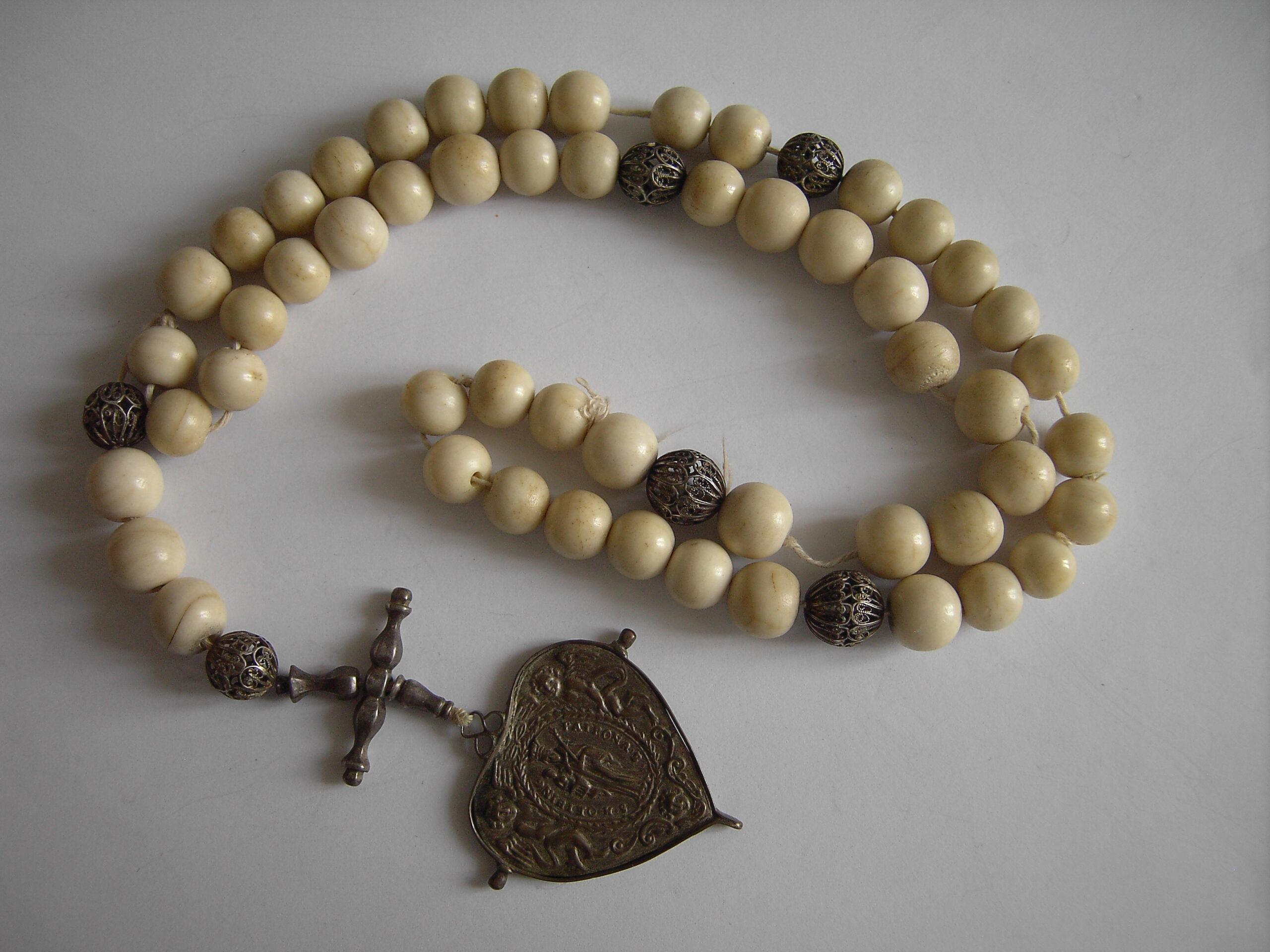
Religious medals bearing the Dorfen cult image circulated in considerable numbers, and although only a small fraction of the original output survives, the durability of their metal substance has preserved them in much greater quantities than the ephemeral scraping Madonnas. They were not, however, generally worn or used in isolation. As surviving objects make plain, medals were predominantly carried as components of rosaries, where they could be touched, kissed, and visually contemplated alongside the recitation of prayers. The rosary thus functioned as the principal carrier medium through which medals entered bodily practices and the devotional life of the faithful. This close relationship is vividly illustrated by the example shown here (see Fig. 6), in which a heart-shaped silver medal is suspended from a rosary of bone beads with filigree paternoster beads. Rosaries were, in all likelihood, the best-selling devotional object of the shrine. Sales at Dorfen rose steadily over the course of the eighteenth century. They were initially supplied by itinerant merchants and by the resident trader Heigl, after her death by her daughter Barbara Eder; from the second half of the century they were increasingly procured from the nearby Altomünster where the production of the Bridgettine rosaries flourished.[57] Gribl has linked this rise to a broader devotional shift, in which the ‘spiritual offering’ of the rosary prayer was gaining ground at the expense of the traditional wax votive.[58] He attributes this development to a broader spiritualisation of early modern Catholic piety, in which immaterial acts of prayer increasingly displaced costly material gifts. Such trajectories, however, are unlikely to be reducible to a single explanation: economic factors — the falling cost of mass-produced prayer beads, the professionalisation of devotional production, and the broadening social base of pilgrimage — may well have been at least as decisive as any shift in spiritual sensibility.
The majority of surviving Dorfen religious medals display the Marian cult image on the obverse, with the chapel on the Ruprechtsberg most commonly depicted on the reverse, while the calvary and Saint Rupert himself appear only rarely.[59] A particularly substantial group combines the Dorfen image with that of Altötting, and these composite medals were produced in a variety of formats, including the so-called Baßgeigen form (violin-shaped medals) on which the two shrines are visually conjoined.[60] Surviving examples include a round silver medal showing the Marian image on the obverse and the chapel on the hill on the reverse, as well as a heart-shaped lead medal without inscription. Such composite objects attest to a Mehrortswallfahrt — a temporally coherent journey to two or more freely chosen, comparable shrines, generally without fixed sequence or liturgical calendar.[61] Gribl distinguished three categories of multiple pilgrimage: shared preconditions (geographical proximity, dynastic patronage, and parallel cult origins), textual evidence (Einzelnachweise) such as pilgrimage and miracle reports, and indicators in the form of small devotional images and objects.[62] The concept of ‘multiple pilgrimage’ is useful to the analysis of regional and supra-regional pilgrimage culture, as it helps to move beyond the focus on individual shrines and their devotional practices and to foreground the interconnections and relationships between them. Recent approaches in pilgrimage studies have sought to bring the locality and (supra-)regionality of shrines into dialogue by directing attention to pilgrimage media such as devotional objects and images as well as the actors involved in their production, distribution, and use. Building on this perspective, Thomas Kühtreiber and Jacqueline Schindler have proposed reversing the traditional narrative of an early modern regionalisation of pilgrimage imposed from above, suggesting instead that we should speak of a regionalisation through pilgrimage: regions emerge as social and cultural spaces, constituted precisely through the communicative and material practices of devotion, and standing in dynamic relation to both local and supra-regional levels.[63] Such pilgrimage sites were linked through media and material connections in two ways: on the one hand, through legendary founders or patrons (as in the case of Altötting and Dorfen, both associated with St Rupert), comparable cult images (particularly Marian ones), and sacred buildings; on the other hand, through media and objects such as pilgrimage and miracle reports, votive images, sacred matter, and sacramentals.
The frequent pairing of Dorfen and Altötting on a single medal fits this pattern with unusual clarity: both were Marian shrines in the Bavarian Electorate, both centred on a venerated cult image, and both lay within reach of overlapping pilgrim networks.[64] Yet whereas Gribl read these objects primarily as ‘indicators’ of a pilgrimage practice that allowed the historian to reconstruct the spatial relations between shrines, I would argue that they should be understood as constitutive elements of that practice in their own right. The medals do more than register such practice retrospectively. As composite objects they themselves produce the linkage between shrines, materially enfolding two spatially distinct sanctuaries into a single artefact that pilgrims could carry on their rosary or on a chain or necklace on the body and activate in their own devotional life. The journey between shrines, undertaken once, was thus translated into a portable and durable medial form, in which the relationship between the two sites could be re-enacted in every prayer. It is important to note that rosary, medal, and scraping Madonna did not operate in isolation but reinforced one another, intensifying the conviction that grace was mediated through matter. The medal acquired its full devotional function only when integrated into the rhythm of rosary prayer; the rosary, in turn, was visually and materially anchored by the medal to a shrine and its sacred power; the clay Madonna, when mounted in a silver setting and attached to the rosary, joined this network as another element, contributing its own logic of inscribed sacred presence. What Gribl described as a spatial relation between shrines thus operates simultaneously at the level of the objects themselves: just as a single medal can fold two sanctuaries into one artefact, a single rosary can fold medal, image, prayer, and ingestible matter into one devotional ensemble. It is precisely this compound effect — a dense, mutually cross-referencing network of text, image, object and substance — that the concept of condensed mediality is meant to capture, and that the case of Dorfen allows us to describe as a case study for a wider historical practice.
Conclusion
The Marian pilgrimage of Dorfen, examined here through its objects, texts and practices, allows us to trace how a regional cult was sustained, intensified and disseminated through the concept of ‘condensed mediality’. The early eighteenth-century expansion of the shrine cannot be understood as the simple consequence of growing pilgrim numbers or of the institutional decisions of clergy and authorities. It rested on the dense interaction of media and objects — cult image, miracle books, sermons, religious medals, rosaries, scraping Madonnas, holy oil — each acting upon the others within a tightly woven network of mutual reinforcement. Printed text legitimated material substance, substance gave rise to new narratives, and narratives in turn drove the demand that sustained the production of further objects. The dispute between Anna Maria Heigl and the Landshut merchants‘ guild made this circuit unusually explicit: what was at stake there was not the marginal sale of cheap sacramentals but a self-perpetuating economy of devotion in which text, object and bodily practice mutually amplified one another.
Three analytical perspectives have structured this argument. Medial condensation described how prints, objects and matters clustered around the shrine and intensified each other’s effects, with the holy oil emerging as a paradigmatic case of substance, text and material setting progressively reinforcing one another over the course of a century. The multifunctionality of objects, examined through the scraping Madonnas, demonstrated how a single, modestly produced sacramental could move across apotropaic, therapeutic, devotional and commemorative registers, and how its material trajectory — from ingestible clay to silver-mounted heirloom — both stabilised and reconfigured its sacred function. Intermedial relations, finally, foregrounded the way in which devotional objects did not operate in isolation but constituted relational networks: the Dorfen-Altötting medal, suspended from a rosary, materially enfolded two shrines into a single artefact that could be carried on the body and re-enacted in daily prayer.
Reading these objects as constitutive media of pilgrimage rather than as illustrations or indicators of a practice shifts the analytical weight of religious history. Pilgrimage at Dorfen was not a pre-existing devotional practice subsequently captured in text and image, but a religious experience brought into being by the very images and objects through which it was mediated. This perspective also reframes the conventional opposition between local and supra-regional, between the singular shrine and the wider network: regions emerge through the practices and media of devotion, not in opposition to them. Dorfen, with its dense circuit of objects, prints and substances and its sustained material pairing with Altötting, offers an unusually clear case in point. What presents itself, on first inspection, as a small Bavarian Marian shrine reveals itself, on closer reading, as a node in a much wider, and materially constituted, early modern devotional culture.
Fußnoten
- On the legend of the Ruprechtsberg as a sacred mountain, see Gribl 1981, esp. pp. 27–33. ⬆
- On the medieval origins of the rosary, see the classical study by Winston-Allen 1997, and, more recently, Buschbeck 2024. On rosary confraternities, see Ranacher 2022. ⬆
- Meyer 2020, https://doi.org/10.13154/er.11.2020.8444. ⬆
- Kürzeder 2005; Ivanič u.a. 2019; Ivanič 2021; Katajala-Peltomaa/Toivo 2016; Kuuliala/Peake 2019. ⬆
- On rosaries and other small devotional objects see, for instance, Toivo 2016; Laven 2017. ⬆
- Gribl 1981; for an art- and architectural-historical perspective on the church and its baroque furnishings, see the work of Nestler 1994. ⬆
- Gribl explicitly positions his study within the phenomenological tradition represented by Rudolf Kriß and Iso Baumer; see Gribl 1981, p. 14. ⬆
- In line with the older Volkskunde, Gribl describes practices of healing magic (“heilzauberische Handlungen”) as merging with the religious sphere of votive observance and pilgrimage, resulting in an interweaving of applied magic (“Anwendungsmagie”) with ecclesiastical articles of faith. Gribl 1981, p. 365. ⬆
- Gribl 1981, pp. 36–40; see also Das uralte 1781, pp. 11f. ⬆
- On the early modern beginnings of the pilgrimage see Gribl 1981, pp. 40–50; see also Nestler 1994, pp. 10–14. Nestler dates the making of the Madonna to around 1470. Ibid., p. 30. ⬆
- “Nun woher / auf was Weiß / und Zeit/ unser Marianisches Gnaden=Bild hiehero gekommen / und in dise Kirch seye eingesetzt worden/ ist ebenfalls noch unbekannt … .“ Quoted after Gribl 1981, p. 23. ⬆
- Das uralte 1781, p. 13. Zur Geschichte der Dorfener Rosenkranzbruderschaft see Gribl 1981, pp. 43–48. ⬆
- Gribl 1981, p. 67; on the history of the altar, see Nestler 1994, pp. 30–31. ⬆
- On the Baroque refurbishment of the pilgrimage church and the cult image itself, see Gribl 1981, pp. 108–116. ⬆
- Gribl 1981, p. 67; Nestler 1994, p. 31. ⬆
- Das uralte 1781, p. 14. ⬆
- Das uralte 1781, pp. 15–16. On the geographical and social origins of the pilgrims, see Gribl 1981, pp. 278–292. Gribl describes the Dorfen pilgrimage as a peasant and middle-class affair, with only a small proportion of civil servants, clergy and nobility. Gribl 1981, p. 292. ⬆
- Das uralte 1781, p. 17. ⬆
- Das uralte 1781, pp. 18f. See on this also Gribl 1981, pp. 284f. ⬆
- On the supra-regional dynamics of the cult and the diffusion of the Dorfen copies, see Gribl 1981, pp. 148–157; for a comparable case study, see in this volume the contribution by Anna Tüskes on the diffusion and iconography of Our Lady of Grace in Re (Piedmont) in the Kingdom of Hungary. ⬆
- For a helpful overview of handwritten and printed miracle reports of Dorfen, see Brenninger 1994, pp. 194–196. For an overview of sacramentals see Gribl 1981, pp. 120–140. ⬆
- [Centuplum II 1723], no. 6. ⬆
- See on the concept of religious wearables the project landing page https://www.imareal.sbg.ac.at/imareal-projekte/religioese-wearables/ (last accessed September 11, 2026); and Kühtreiber/Schindler 2022; Kühtreiber/Puchinger 2027 forthcoming. Drawing on the example of Agnus Dei, Paul Nelles describes sacramentals as “mobile proxies for things very much fixed in place.” Nelles 2023, p. 186. ⬆
- [Ederin, Barbara], Krämerin zu Dorfen. BayHStA. Hofrat A 70. All subsequent quotations and references in this article draw on the same unpaginated file and will not be cited separately. ⬆
- The Rentmeister headed one of the four Bavarian Rentämter (Landshut, Munich, Burghausen and Straubing). Originally a fiscal office, the Rentmeister’s role had by the sixteenth and seventeenth centuries expanded to include administrative, policing and partial judicial competences. His regular tour of inspection through the district, the Umritt, served among other things to receive and adjudicate local disputes. ⬆
- The Elector's commitment to the shrine was not merely administrative: on 15 August 1719, the feast of the Assumption of Mary and the patronal feast of the Dorfen pilgrimage church, Maximilian II Emanuel himself undertook a pilgrimage to Dorfen, thereby lending the cult his personal devotional endorsement. Das uralte 1781, p. 18. ⬆
- After Heigl's death, further conflicts arose. Her daughter Barbara Eder had taken over her late mother's devotional trade and petitioned the Elector in 1726 for permission to continue it. [Ederin, Barbara] BayHStA, Hofrat A 70. ⬆
- Woeckel 1992. ⬆
- Gribl 1981, pp. 367–371, on the different uses of the holy oil against physical and mental illnesses. ⬆
- On Triberg, see Schmalfeldt 1988, esp. 152–156; on Eichstätt, see Zunker 2018, esp. 411–417. ⬆
- Limor 2017. ⬆
- It is miracle no. 227 in Sailler 1713, p. 194. ⬆
- Gribl 1981, p. 126. ⬆
- See the descriptions of miracles nos. 5, 33, 99 in [Centuplum I 1718], pp. 2, 15, 47. ⬆
- Gribl 1981, p. 127. ⬆
- Gribl 1981, p. 127. ⬆
- Gribl 1981, p. 130. ⬆
- Das uralte 1781 1781, pp. 46f., 55f., 65, records the healing of an infant, of Katharina Hinterkirchner of Tittmoning from a sore throat and of Maria Mayr of Achdorf from lameness, as well as a further five oil-miracles grouped in a separate section, ibid., pp. 78–80. ⬆
- Gribl 1981, p. 370. ⬆
- The term probably designates a destructive, ulcerating infection that could spread from the skin into deeper tissues. Campe 1811, p. 795. ⬆
- [Centuplum III 1727], no. 95, p. 41. ⬆
- [Centuplum I 1718], no. 79, p. 37f. It was probably Wilhelm Carl Freiherr von Lerchenfeld († 1739). ⬆
- Older research interpreted such practices as 'mechanistic' deviations from authorized devotional norms or even ‘misuse’; see, for instance, Gribl 1981, p. 370. ⬆
- Gribl 1981, p. 135. ⬆
- Kühtreiber/Miesgang (im Druck). See on the practice of scraping also Kürzeder 2005, p. 129. ⬆
- Kühtreiber/Miesgang (im Druck). ⬆
- Gribl 1981, pp. 130–132. ⬆
- I am grateful to Matthias Witzleb, Museum Director at the Museum Dingolfing, for kindly allowing me to examine the Schabmadonna at first hand and for his generous help with information concerning the object. ⬆
- On holy dust see Miesgang 2025, https://doi.org/10.25536/20251201. ⬆
- Gribl 1981, p. 372. ⬆
- Das uralte 1781 1781, p. 49. ⬆
- Kürzeder 2005, p. 148. ⬆
- [Centuplum II 1723], no. 61, p. 28. ⬆
- [Centuplum II 1723], no. 100, p. 47f. ⬆
- Numerous examples of rosaries with Scraping Madonnas have survived in the Sammlung Kriss (collection Kriss) held in the Bayerisches Nationalmuseum. ⬆
- Grasmann 1980, p. 25. ⬆
- Bridgettine rosaries were blessed at the convent of Altomünster and carried high indulgences, which made them particularly sought after among Catholics. ⬆
- Gribl 1981, p. 139. ⬆
- Gribl 1981, pp. 136–138. ⬆
- See the rather implicit use of the concept in Kriss 1953-1956 and Gugitz 1955. On the definition of the term, see Gribl 1981 who uses the examples of Dorfen and Altötting. ⬆
- The frequency of this combination is striking: of forty-eight Dorfen medals in the Kriss Collection of the Bavarian National Museum, thirty-six (c. 75 %) feature the Altötting cult image on the opposing side, and across a wider sample of 78 surviving examples drawn from several collections, more than 70 % pair the two shrines. Gribl 1981, p. 202. ⬆
- Gribl 1981, p. 193. ⬆
- Kühtreiber/Schindler 2022. ⬆
- Gribl 1981, p. 193. ⬆
Bibliographie
Wird erwähnt in Fußnote: [24] [27]
Wird erwähnt in Fußnote: [21]
Wird erwähnt in Fußnote: [2]
Wird erwähnt in Fußnote: [40]
Wird erwähnt in Fußnote: [34] [42]
Wird erwähnt in Fußnote: [22] [53] [54]
Wird erwähnt in Fußnote: [41]
Wird erwähnt in Fußnote: [9] [12] [16] [17] [18] [19] [26] [38] [51]
Wird erwähnt in Fußnote: [56]
Wird erwähnt in Fußnote: [1] [6] [7] [8] [9] [11] [12] [13] [14] [15] [17] [17] [19] [20] [21] [29] [33] [35] [36] [37] [39] [43] [44] [47] [50] [58] [59] [60] [61] [62] [64]
Wird erwähnt in Fußnote: [60]
Wird erwähnt in Fußnote: [4]
Wird erwähnt in Fußnote: [4]
Wird erwähnt in Fußnote: [4]
Wird erwähnt in Fußnote: [60]
Wird erwähnt in Fußnote: [4]
Wird erwähnt in Fußnote: [23]
Wird erwähnt in Fußnote: [45] [46]
Wird erwähnt in Fußnote: [23] [63]
Wird erwähnt in Fußnote: [4] [45] [52]
Wird erwähnt in Fußnote: [5]
Wird erwähnt in Fußnote: [31]
Wird erwähnt in Fußnote: [3]
Wird erwähnt in Fußnote: [49]
Wird erwähnt in Fußnote: [23]
Wird erwähnt in Fußnote: [6] [13] [15]
Wird erwähnt in Fußnote: [2]
Wird erwähnt in Fußnote: [32]
Wird erwähnt in Fußnote: [30]
Wird erwähnt in Fußnote: [5]
Wird erwähnt in Fußnote: [2]
Wird erwähnt in Fußnote: [28]
Wird erwähnt in Fußnote: [30]